 OMGLoftClassic games. Real players.
Backgammon
Bear off all fifteen checkers first.
Create a table with the button above — players in the room will see it on the list and join you.
How to play — Backgammon
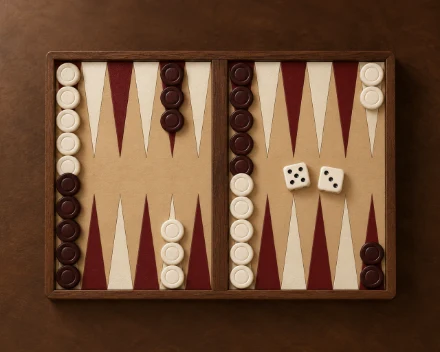
Backgammon online for 2 players — free, in your browser, no sign-up needed (you play as a guest right away). Join a table or open your own.
Show less
In short
Each player has 15 checkers and rolls two dice. The numbers on the dice tell you how many points to move your checkers. You must bring all your checkers into your own quarter of the board and then bear them off. A single checker can be hit, while two or more on the same point protect each other. The first player to bear off all their checkers wins.
Goal and direction of movement
Two players have 15 checkers each on 24 triangular points. They move in opposite directions towards their own home board, which is the last six points, and then bear checkers off the board. You win by bearing off all your checkers before your opponent.
Starting position of the checkers: dark and light. Rolling and moving
Press “Roll dice”, select a checker and choose the destination point. Each die is a separate move. A roll of 3 and 5 lets you move two checkers, or one checker by 3 and then by 5, as long as both steps are allowed. A double gives four moves of the same length. You must use as many moves as possible. If only one of two different dice can be used and each is possible on its own, you must use the higher one.
Hitting and the bar
You cannot move onto a point occupied by two or more opposing checkers. A single opposing checker there is hit and goes to the bar in the middle. While you have checkers on the bar, you must first enter them into your opponent's home board according to the dice. Blocked entry points may make it impossible to use your roll.
Bearing off
You may bear checkers off only when all your other checkers are in your home board. Use the exact number on a die. A higher number may be used only for the checker furthest from the exit, if you have no checker further back. If one of your checkers is hit, bearing off is suspended until it returns to your home board.
Points and doubling
An ordinary win scores 1 point. If the loser has not borne off any checker, the win scores 2 points. If the loser also has a checker on the bar or in the winner's home board, it scores 3 points. The result is multiplied by the value of the doubling cube. A double is offered before rolling. Accepting doubles the stake and passes the right to the next double to the receiver. Declining gives up the game at the current stake. Offers to concede for 1, 2 or 3 mean the corresponding value of the loss multiplied by the stake. Your opponent may accept or decline, and if declined the game continues. In the game right after someone gets within one point of the match goal, doubling is not allowed (the Crawford rule). With the “Doubling cube” option off, the game is played without doubling and each game is worth 1, 2 or 3 points.
The match and the clock
Each game starts with an opening roll: each player rolls one die (a tie means rolling again), and the higher result starts and immediately plays both numbers rolled. The winner is the player who reaches the set point target. A clock written 1/12 means one minute of base time and 12 seconds of delay in each turn: base time is reduced only after the delay. The notation 1×/12 gives a base minute multiplied by the match target. The delay does not add unused seconds to your reserve.