 OMGLoftClassic games. Real players.
Canasta
Meld seven cards of a rank. Two decks and four jokers.
Create a table with the button above — players in the room will see it on the list and join you.
How to play — Canasta
Canasta online for 2–4 players — free, in your browser, no sign-up needed (you play as a guest right away). Join a table or open your own.
Show less
In short
Canasta is a card game for two players individually or four players in partnerships sitting opposite. You build melds of cards of the same value, and especially valuable are canastas, which are melds of at least seven cards. Sequences of consecutive values are not melds here.
The deal
Two full decks and four jokers are used. With two players each gets 15 cards, with four each gets 11.
Turn and melding
On your turn draw one card from the stock or legally take the whole discard pile. Then you may lay down new melds and add to the melds of your side already on the table. At the end discard a card. A meld has at least three cards, including at least two natural cards of the same value. Twos and jokers substitute for missing cards, but a single meld may contain at most three such substitutes. Threes are not laid into ordinary melds.


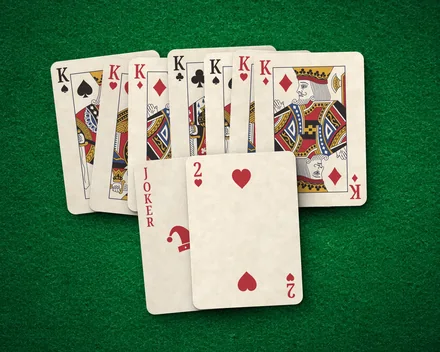
An example meld of sevens: three natural cards and a two standing in for a missing one. The first meld
The first set of melds laid down must reach a threshold depending on your side's score so far: 15 points with a negative score, 50 below 1500, 90 below 3000, and then 120. A joker is worth 50 points, an ace and a two 20, cards from eight to king 10, and the rest 5. Bonus points for a canasta do not count towards the value required for the first meld.
Taking the pile
The top card must go at once into a valid meld: with cards from your hand or, when the pile is not frozen, into an existing meld. You take the rest of the pile into your hand. A discarded two or joker freezes the pile until it is taken. Taking a frozen pile requires at least two natural cards from your hand matching the top card's value. A black three on top blocks taking the pile, because it cannot go into a meld. Red threes are laid aside automatically and replaced with cards from the stock.
Going out and settling
To get rid of your last card, your side must have the required one or two canastas. Without them you also may not lay down so that one card remains in your hand, because discarding it would be going out. Empty hands end the deal. When the stock runs out, play continues as long as the following players take the discard pile. You must take it if its top card fits a meld of your side, and whoever cannot or does not want to take it ends the deal.
Points
The values of cards laid down count, minus the values of cards left in hands. A pure canasta with no substitutes adds 500 points, a mixed one 300, and going out 100, or 200 when you lay down all your cards at once with no earlier melds. Each red three adds 100 if the side has at least one meld on the table, and subtracts 100 if it has none. After the set point target is reached, the highest score wins. There is no resigning: leaving a game in progress, or running out of time, is a forfeit by that player (in a pairs game, by their pair) and ends the game for the whole table, and the others win.