 OMGLoftClassic games. Real players.
Chess
The classic strategy game. Develop your pieces, build threats and deliver mate.
Create a table with the button above — players in the room will see it on the list and join you.
How to play — Chess
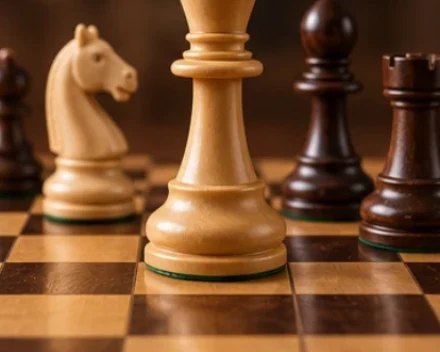
Chess online for 2 players — free, in your browser, no sign-up needed (you play as a guest right away). Join a table or open your own.
Show less
In short
Chess is a game for two players. You play White or Black, and you take turns making one move each. There is one goal: checkmate, which means attacking the opposing king so that it can neither defend itself nor escape.
Board and pieces
You play on an 8×8 board. Each side starts with 16 pieces: a king, a queen, two rooks, two bishops, two knights and eight pawns. White moves first. To move, select your own piece and then one of the squares it can legally go to.
How the pieces move
• Rook: any number of squares in a straight line, horizontally or vertically. • Bishop: any number of squares diagonally. • Queen: combines the rook and the bishop. • King: one square in any direction. • Knight: two squares in one direction and one to the side (described below). Except for the knight, no piece can jump over others. You capture an opposing piece by moving onto its square.
The knight: an L-shaped move
The knight moves two squares in one direction and then one square to the side. It is the only piece that can jump over other pieces, yours or your opponent's. The diagram shows every square a knight can reach from the middle of the board.
Knight: the eight squares it can jump to from the middle of the board Pawns and promotion
A pawn moves one empty square forward. From its starting square it may move two squares if both are empty. It captures one square diagonally forward, not straight ahead. When a pawn reaches the last rank, you choose whether it becomes a queen, rook, bishop or knight. There is also en passant: it is possible only immediately after a neighbouring pawn has moved two squares. Your pawn then moves onto the square that pawn just jumped over.
Check: an attack on the king
You may never leave your own king attacked. When a king is attacked, it is called check. You must react: move the king, capture the attacker or block the attack when you can. In the diagram the white rook on e1 attacks the black king on e8 along the whole file, so it is check. Black can move the king to a square the rook does not attack, for example d8.
Check: the white rook on e1 attacks the black king on e8 Castling
Castling is the only move in which you move two pieces at once. The king moves two squares towards a rook and the rook lands on the king's other side. It is allowed only if neither the king nor that rook has moved before and the squares between them are empty. The king may not castle out of check, through an attacked square or into one.
How a game ends
Checkmate wins. Stalemate is a draw: the player is not in check but has no legal move. A draw can also come from a position where nobody can checkmate any more, from repeated positions, from long play without captures or pawn moves, or from an accepted draw offer. With threefold repetition, or after 50 moves by each side without a capture or pawn move, you can claim a draw. With fivefold repetition or 75 such moves the game ends automatically, unless the last move was checkmate. The interface shows the claims available. Resigning ends the game.
The clock
At the table you set each player's time per game (1 to 60 minutes) and an increment added after every move (0 to 30 seconds). Normally the player who runs out of time loses. If the opponent can no longer checkmate, the result is a draw.