 OMGLoftClassic games. Real players.
Go / Baduk
Surround territory and enemy stones.
Create a table with the button above — players in the room will see it on the list and join you.
How to play — Go / Baduk
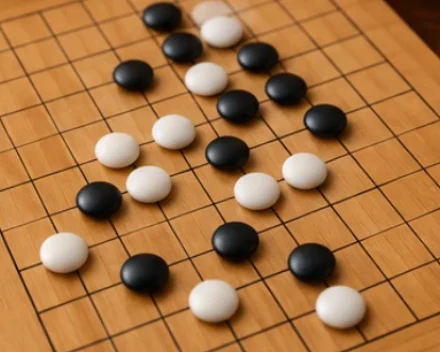
Go / Baduk online for 2 players — free, in your browser, no sign-up needed (you play as a guest right away). Join a table or open your own.
Show less
In short
Go is a game for two players. You take turns placing one stone on an intersection of the lines, and stones do not move. A group of stones surrounded by your opponent on all sides is removed from the board. When both players pass, the surrounded territory and the captured stones are counted. The player with more points wins.
Board and stones
Two players use black and white stones. Black moves first. Stones are placed on the intersections of the lines, not inside the squares. The board can be 9×9, 13×13 or 19×19 intersections. The goal is to win more area than your opponent. On your turn you place one stone or pass.
Groups and liberties
Stones of the same colour that touch vertically or horizontally form a group. The empty intersections next to a group are its liberties. A diagonal connection does not join stones into a group.
Capturing
An opposing group loses all its stones when you take its last liberty. Captured stones go to you as prisoners and count as points.
The white stone has one liberty (marked point). When Black plays there, it captures it. Forbidden moves
You may not place a stone if, after captures are resolved, your group would have no liberties. It is also forbidden to recreate an earlier arrangement of stones on the board, so in some situations an immediate recapture is not available.
Ending the game and counting
The game ends with two consecutive passes if White passed last. A pass by Black after a pass by White does not end the game yet. Then you mark the groups considered dead, meaning those that can no longer be saved by further play. Clicking changes the marking of a whole group and clears earlier confirmations of the result. Both players must accept the same result. If you disagree, play can be resumed; after two minutes with no decision the game resumes automatically. After resuming, play continues until the next two passes (White passes last). Then the result is counted at once and everything standing on the board is alive.
Scoring
Scoring follows AGA rules: one point for every empty intersection surrounded only by your colour and for every prisoner, meaning a captured opposing stone. Each pass gives your opponent one stone as a prisoner, so the result is the same as when counting area (stones on the board and surrounded intersections). Territory touching both colours is neutral. White gets a komi to choose from: 0.5, 5.5, 6.5 or 7.5 points, 6.5 by default. With a handicap (1–9 black stones at the start) the komi is 0.5. The komi always has a half point, so there are no draws: the higher total wins.
The clock
At the table you set each player's time for the whole game (1 to 60 minutes). The clock runs only on your turn. After the main time, byo-yomi overtime begins: within the chosen time (1 to 20 minutes) you must make 25 moves, and then the overtime starts again. Whoever fails to keep up loses.