 OMGLoftClassic games. Real players.
Ludo
Race your pieces home first.
Create a table with the button above — players in the room will see it on the list and join you.
How to play — Ludo
Ludo online for 2–4 players — free, in your browser, no sign-up needed (you play as a guest right away). Join a table or open your own.
Show less
In short
Each player has four pieces in their base. You roll a die and move a piece as many squares as you rolled. A piece leaves the base only after you roll a six. When you land on a square with an opposing piece, it goes back to its base. The first player to bring all four pieces into their home wins.
Board and setup
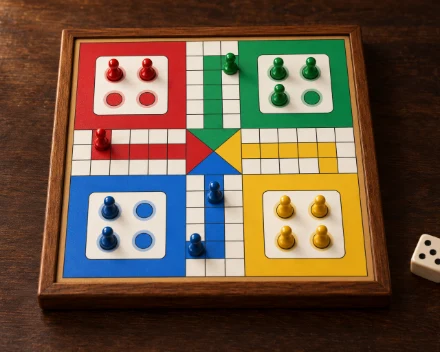
2–4 players take part. Each has four pieces in their base, the coloured house in a corner of the board. Your task is to bring all four around the shared track to the four home squares in your colour. With two players the bases are opposite each other.
The Ludo board: four bases, the shared track and the home squares Leaving the base
The die lies in the base of the player whose turn it is. When you have no piece on the track, click it to roll. When you have, the roll happens by itself and you choose a piece. A six brings a piece from the base to the starting square. If you have a piece in the base and your own piece is not on the starting square, leaving is compulsory. When the base is empty or your own piece occupies the starting square, a six moves a piece that is already in play. If all your pieces are still in the base or already home, you may get up to three tries at rolling. A turn with no legal move is handled automatically.
Moving and capturing
After the roll, choose the piece that is to move. It moves exactly the number of squares rolled, in the direction of the track. You cannot finish a move on your own piece. Landing on an opposing piece on the shared track sends it back to its base, and to return to play it must roll a six again.
Extra rolls
A six gives another roll, but a series ends after the third six in a row at the latest. The third move is not cancelled. A capture alone does not give a separate bonus roll. Before moving you decide which of the available pieces uses the result.
Home and winning
After going around the track, a piece enters its own final squares, where opponents cannot capture it. A move may not go past the last square or end on your own piece, so sometimes you have to wait for the right number. In the home you may jump over your own pieces. You win when all four pieces are home. They do not have to reach the same square one after another.
Table and match
At the table you choose the number of players (2, 3 or 4), the time per game for each (2 to 15 minutes) and a match to 1, 2 or 3 wins. Each next game of the match starts from the initial setup, with full time for everyone. The player sitting after the winner of the previous game rolls first. With two players you sit in seats #1 and #4, in opposite corners.
When someone leaves
If at least two players remain, the pieces of the player who leaves the game disappear and that seat is skipped in the turn order. The remaining pieces and their colours keep their positions. The last player remaining wins. Players who have left end their participation with a forfeit.