 OMGLoftClassic games. Real players.
Makruk
Thai chess with its own pieces.
Create a table with the button above — players in the room will see it on the list and join you.
How to play — Makruk
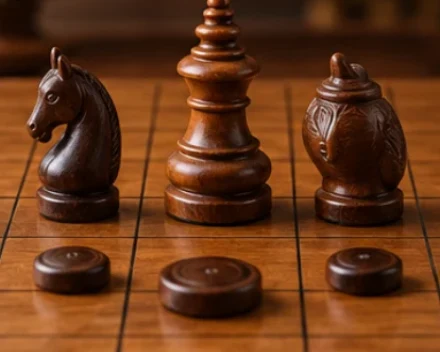
Makruk online for 2 players — free, in your browser, no sign-up needed (you play as a guest right away). Join a table or open your own.
Show less
In short
Makruk is Thai chess: an 8×8 board and the same goal as in chess, which is checkmate. The rook, knight and king move as in ordinary chess. The met (instead of the queen) and the khon (instead of the bishop) are weaker and move only one square. Pawns start one row further forward and move like a met after promotion.
Starting position of the pieces in makruk Pieces and setup
Each side has a king, a met, two rooks, two knights, two khons and eight pawns. Pawns start on the third row from your side. You win by checkmating the opposing king.
King, rook and knight
The king moves one square in any direction and may not move into attack. The rook moves any number of squares vertically or horizontally, without jumping over obstacles. The knight moves like the chess knight: two squares in one direction and one perpendicular to it. It may jump over other pieces.
Met and khon
The met stands next to the king and moves only one square diagonally, so it is much weaker than the queen in classical chess. The khon can move one square diagonally in any direction or one square straight forward. These pieces also capture by moving onto an opposing piece's square.
Pawns and promotion
A pawn moves one empty square forward and captures one square diagonally forward. There is no two-square first move and no en passant. When a pawn reaches the sixth row counted from its own side, it is promoted and moves like a met. There is no castling in this game.
Check and checkmate
When your king is attacked, you must answer with a move that removes the threat. If that is impossible, it is checkmate and you lose.
Draws
A game is drawn by stalemate, by the third repetition of a position (counted from the last capture, pawn move or promotion), and when nobody has the means to give checkmate any more. When there are no pawns on the board, the weaker side counts moves: normally up to 64, and when it has only a king left, up to 8 (against two rooks), 16 (a rook), 22 (two khons), 32 (two knights), 44 (a khon) or 64. The count starts from the number of pieces on the board. If checkmate does not occur before the count ends, the game is drawn. You may also resign or agree a draw.
The clock
At the table you set each player's time for the whole game (1 to 60 minutes) and an increment added after every move (0 to 10 seconds). The clock runs only on your turn. When your time runs out, you lose. After you select a piece, the board shows the moves available.