 OMGLoftClassic games. Real players.
Skat
Win the bidding and play alone. The skat can change it all.
Create a table with the button above — players in the room will see it on the list and join you.
How to play — Skat
Skat online for 3–4 players — free, in your browser, no sign-up needed (you play as a guest right away). Join a table or open your own.
Show less
In short
Skat is a game for three or four players. In each deal one player, the declarer, plays alone against two defenders. You bid the value of the game, and the declarer chooses what is trumps. They need at least 61 of the 120 points in cards to win an ordinary contract.
Setup
In each deal three players get cards. With four players the dealer sits out, and the dealer role moves on after the deal. Each active player receives 10 cards from a 32-card deck from seven to ace. Two face-down cards make up the skat. A match covers 1–4 full rounds: three deals each with three players or four each with four. The highest total of match points wins.
Bidding
The first player after the dealer answers the next player's bid: they choose Hold or Pass. The bidder may raise or pass. Then the third active player joins the bidding. The winner of the bidding plays alone against two defenders. The lowest bid is 18, and the interface shows the allowed values. When two players pass without a bid, the first may accept 18 or pass too. Everyone passing ends the deal with no points.
The skat and the contract
The declarer picks up the skat and then puts down any two cards. They may instead choose to play from the hand (Hand) and not look at the skat. Then they confirm a trump suit, Grand or Null. In Ouvert their hand is open. Open suit contracts and Grand, and the Schneider and Schwarz announcements, require playing from the hand, while Null Ouvert may also be played after picking up the skat.
Cards and tricks
A trick is one card from each active player. The first is led by the first player after the dealer, the following ones by the winner of the previous trick. You must follow suit if you have that suit, and without it you may play any card. In a suit game the four jacks are the highest trumps: clubs, spades, hearts, diamonds. After them, in the trump suit and in the other suits, the order is A, 10, K, Q, 9, 8, 7. In Grand only the jacks are trumps. A jack belongs to the trumps, not to its printed suit. The highest trump takes the trick, and with no trump the highest card of the suit led. In Null there are no trumps and the order is A, K, Q, J, 10, 9, 8, 7.


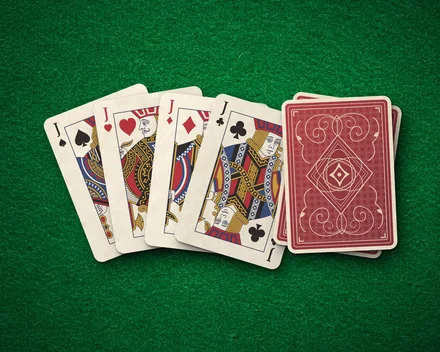
The four jacks are the highest trumps, from the highest: clubs, spades, hearts, diamonds. Winning the contract
An ace is worth 11 points, a ten 10, a king 4, a queen 3, a jack 2, and the other cards zero. There are 120 points in the whole deck. The points of the two skat cards belong to the declarer. For an ordinary win they need at least 61. An announced Schneider requires at least 90, and Schwarz and an open suit contract or Grand require all 10 tricks. In Null the declarer may not take any trick, and taking the first ends the deal with a loss.
Match scoring
The base value is: diamonds 9, hearts 10, spades 11, clubs 12, Grand 24. The game multiplies it by the consecutive trumps held or missing starting from the jack of clubs, increased by the game levels: ordinary, Hand, Schneider, announced Schneider, Schwarz, announced Schwarz and Ouvert. Schneider means 30 or fewer points for one side, and Schwarz means no tricks for it. The skat is also taken into account when counting trumps. Null has fixed values: 23, Hand 35, Ouvert 46, Hand Ouvert 59. A won contract adds its value to the declarer, and a lost one subtracts double the value. Defenders score zero for the deal. Overbidding means a loss even with enough points in the cards, and the negative value must cover the bid.
Leaving and the next game
There is no resigning. Leaving a match in progress (also by a player sitting out), or running out of time, is a forfeit by the leaver and ends the match for the whole table, and the others win. After the end the board stays visible, and the next START begins a new match. The clock and the time added per move come from the table settings.