 OMGLoftClassic games. Real players.
Turkish Draughts
Draughts moving along rows and columns.
Create a table with the button above — players in the room will see it on the list and join you.
How to play — Turkish Draughts
Turkish Draughts online for 2 players — free, in your browser, no sign-up needed (you play as a guest right away). Join a table or open your own.
Show less
In short
In Turkish draughts the pieces move straight rather than diagonally: one square forward or sideways. You capture by jumping over an opposing piece, and capturing is compulsory. You win when your opponent has no pieces left or cannot move.
Board and setup
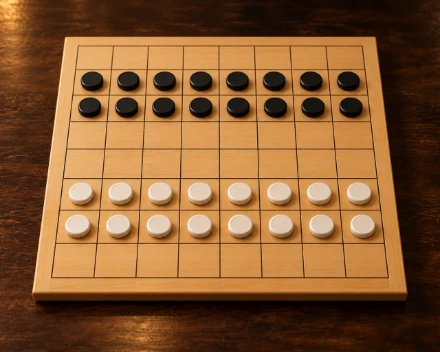
Two players play on an 8×8 board. Each has 16 pieces in two full rows, and the back row behind the pieces is empty. The player with the light pieces moves first.
Starting position in Turkish draughts Moving a piece
A piece moves one empty square forward, to the left or to the right. It does not move diagonally or backwards.
Kings
A piece that finishes its move on the opponent's last row becomes a king. A king moves any number of empty squares horizontally or vertically. It gets its new powers only on the next move.
Capturing is compulsory
When you can capture, you may not make an ordinary move. A piece jumps over an adjacent opposing piece onto the empty square directly behind it, forwards or sideways. A king can reach an opposing piece along a row or a column and land on any empty square behind it. A captured piece disappears at once, which may open up another capture.
Multiple captures
You must keep capturing for as long as it is possible. Choose the route that takes the most pieces (a man and a king count the same). With equal options the choice is yours. A king cannot turn back 180 degrees between jumps. Select a piece and then each highlighted landing square in turn. Only the last jump confirms the whole series.
How a game ends
You win when your opponent has no pieces or cannot move. One piece against one piece is a draw. A draw also follows the third repetition of the same position with the same player to move, and an accepted draw offer. Resigning or running out of time loses the match.
The clock and the table
At the table you set each player's time for the whole game (1 to 60 minutes) and an increment added after every move (0 to 10 seconds). The clock runs only on your turn. When the game ends the last position stays on the board, and START sets up new pieces.