 OMGLoftClassic games. Real players.
Xiangqi
Chinese chess with river and palaces.
Create a table with the button above — players in the room will see it on the list and join you.
How to play — Xiangqi
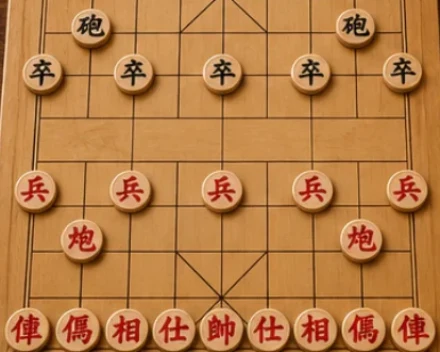
Xiangqi online for 2 players — free, in your browser, no sign-up needed (you play as a guest right away). Join a table or open your own.
Show less
In short
Chinese chess (xiangqi) is a game for two players. The pieces stand on the intersections of the lines, and a river divides the board in half. The general, which is the king, may not leave its own 3×3 palace. Every piece has its own way of moving. You win by attacking the opposing general so that it has no defence.
Starting position of the pieces in xiangqi The board
The pieces stand on the intersections of nine vertical and ten horizontal lines. A river divides the middle of the board, and each side has a 3×3 palace. Red moves first. The goal is to leave the opposing general with no defence.
The general and the guards
The general moves one intersection vertically or horizontally, and only inside its own palace. The two guards move inside the palace, one intersection diagonally. The two generals may never face each other on the same vertical line with no piece between them.
Chariot, cannon and horse
The chariot moves like a rook in chess: vertically or horizontally along a clear path. The cannon moves the same way when not capturing, but to capture it must jump over exactly one piece, of either colour, standing between it and the target. The horse moves first one point straight, then diagonally outwards. If that first, adjacent point is occupied, the horse's move is blocked.
Elephant and soldier
The elephant moves exactly two intersections diagonally. It cannot cross the river, and an occupied point in the middle blocks its move. A soldier before the river moves and captures one point forward. After crossing the river it may also move and capture one point sideways. It never moves backwards and never promotes to another piece.
Check and the end of the game
You may not make a move that leaves your own general under attack. Checkmate wins, and having no legal move also loses, even without check. A draw follows 60 moves by each side without a capture (with frequent checks the limit is extended) and when neither side has a chariot, horse, cannon or soldier left. When a position occurs for the third time, the player who was giving check all the time (perpetual check) or chasing an unprotected piece (perpetual chase) loses. If both sides do it, or neither, the game is drawn. You may resign or accept a draw offer.
The clock
At the table you set each player's time for the whole game (1 to 60 minutes) and an increment added after every move (0 to 10 seconds). The clock runs only on your turn. When your time runs out, you lose.